Showing posts with label opinion piece. Show all posts

Wednesday, October 9, 2013

#80 in praise of: kathleen battle

Kathy used to be so hot, as in, legitimately hot.

Oy. People always have "but" when describing Kathleen Battle. "She had a beautiful voice, but..." "Sure she had great coloratura, but..." "She's really great with fans, but..." Fact is many, many, many people hate Kathleen Battle. But that was not her downfall: in fact, it was her decision to sing Zerbinetta.


The voice itself is one of the most beautiful timbres ever produced in USA. It is small, but in its early years it had a piercing quality, and in the notes above the staff sounded as if it could extend itself upwards forever. She excelled especially in oratorio music and Mozart. In fact, I suspect that if she were to remain an exclusively concert-recital artist in the vein of Marian Anderson she would still have a wonderful, fulfilling career as of 2010's. In fact she's still doing jazz performances and the rare recitals.


Of course when talking of Battle we also have to talk about her face - or faces. Another issue was the cloying quality of her middle and upper-middle voice which crept in during the early 80's. She probably felt these contortions helped her intonation, and undoubtedly the cloying sweetness in her voice was a tremndous advantage in crossover rep - it made her voice sounds like a cross between a clarinet and a theremin - but it began to drag her voice down. Her first Zerbinetta's in Covent Garden still had the child-like purity and pearl-like sparkle in the upper voice - a wonderful chest-middle which sounds exactly like her speaking voice was a bonus - but all that disappeared by the time she brought her Zerbinetta to the Met.


Then of course there was the high notes. She could produce them at will, but high D's and Eb's seems to be the limit. By the time of the Met Zerbinetta's the high E has became harsh, scream-like. The quality also changed, earlier they had a laser-like brightness which became velvety and marshmallow-y: no doubt very beautiful sounds all but did not count much projection-wise.


Fortunately she had one of those voices which do as well in crossover music as they do in classical-opera. She became a great proponent of spirituals, and her jazz work is not to be sneezed at, especially her beloved "Creole Love Song", with her in a slinky red dress undulating sinously among her combo members.


It's a loss, a great loss. Who'd predict where Kathy could have gone? When she was fired by the Met she was singing Marie's and Adina's, perhaps she could have went on to Amina. There were talks of Lulu. She was one of the great Handelians of her day, as proved when her Carnegie Hall Semele, with colleagues like Marilyn Horne and ... became a great turning point for Handelian singing in the US. She would have been great in early music like Vivaldi and the Neapolitan school. I shudder to think how her "In furore iustissimae irae" would've sound like. Her French arias album was a gem, as well as her belcanto album. She certainly had the personality for the great operetta parts, like Hanna Glawari, Rosalinde et al. She was also not afraid to venture out, singing Spanish and Catalan lullabies and made-up nonsense Greek. Finally, she would have been great in Broadway, where the size of her voice won't be a factor.


Perhaps I have a bias towards her, because she was my first diva, and like the first fuck you never forget your first diva. I am ashamed to admit I first fell in love with Battle not in opera, not in lieder, but first after hearing her singing the theme from "House of Flying Daggers". Sue me for tackiness, but I have to say that song - or rather, her singing of that song - inspired my great love affair with classical singing. So thank you, Kathy, for making me who I am today.

Saturday, August 31, 2013

#79 in praise of: anna moffo

Happy Independence Day, Peninsular Malaysia (because Malaysia didn't achieve total independence until Malaysia Day and I'm bitter like that, heh)!

This is going to be the first in a series of few posts which will be unashamedly about diva-worship. Other opera fans who are claiming to be above such things can go fuck themselves.

The young Anna Moffo circa 1956-59,
before the rhinoplasty and (glorious) weaves

I'd like to start this series with Anna Moffo. Girl was gorgeous. Girl had voice - in spades, literally: she sang Elisabetta on stage. Girl had talent aplenty. So what the fuck happened? According to Herself, it was her first husband who drove her faculties to distraction and extreme fatigue, ultimately destroying one of the most beautiful (soprano) voices to come out of the land of Buffalo wings and french fries.

I first heard Anna Moffo from a YouTube video of her singing Marguerite's Jewel aria in what looked like a fluff-piece cabaret concert. Girl looked fierce, but had no trill to speak off (that impression was wonderfully changed later, of course). I noted though her voice sounded like sex personified. It had throb, it had sensuality, it sounded atrociously *female*. This is the kind of voice you can imagine hearing from her side of the bed after an all-night orgy.

Then I heard her singing a song from Showboat, Bill, as one of the songs from her Italian RAI television show. I don't know then, but I fell in love with her the moment I heard "I don't know" from her lips. I couldn't help it. There's something about the way she phrased this standard that made you believe even though she's probably fucking around this Bill fellow's back, she really did love him, at least when it all first started.

I sound like a crazy fan. I am. I now am the proud owner of several Anna Moffo recordings, including the greatest La rondine ever recorded, a daring take on Luisa Miller, a Madama Butterfly which made a powerful case for the lighter voice (Gheorghiu, I'm looking at you), a perfectly balanced Lucia di Lammermoor with Gorgeous Charlie (passport name: Carlo Bergonzi), even the shitty ones like the duse of crap, the Thaïs recording with the young José Carreras, and the tear jerker of the lot, L'Amore dei tre re.

Her recording which I love most was of course the Rondine. She made Magda sympathetic, which is of course really hard to do. I love the fact that she did not made the dream aria the centerpiece, but gave that place of honor to Ore dolci e divine. Her duets with Daniele Barioni were living gems. The wonderful Act 2 quartet did not turn saccharine, but kept the momentum going: happiness is effervescent, after all.

The second was her L'Amore dei tre re with Domingo and daddy a.k.a. Cesare Siepi. This was unfortunately for a sadder reason: to wonder how the fuck everything come to this. At least the Thaïs was a camp-fest. I couldn't help crying the first time I listened to Moffo's first phrase: "Ritorniamo", intoned in a hoarse middle voice. Return to what? It was a ruin of a voice, but what a magnificent ruin.

Maybe that was the problem. Moffo wasn't exactly a musical genius like Callas was, in the way she never made a phrase her own. Okay, I am probably too harsh; I've heard at least two phrases which had never been bettered by anyone else: "Tu sei con Dio ed io con mio dolor" from Madama Butterfly, and "Per non vederlo più!" from the live 1961 Met Turandot, in which everyone in the cast, even the chorus, was perfect.

But that was not the problem. The problem with Moffo was, once you get through the sheer gorgeousness of her timbre - and that was a great deal of fabulous you have to get over - she was at most an extremely competent singer who happened to have beautiful physical features, and fact is people are shallow like that. I do heard that she was a wonderful affecting actress on stage. I've seen her films: the Sonnambula, Madama Butterfly (which made her one of Italy's most beautiful women) and the Traviata. She indeed looked wonderful and had the operatic naturalism acting style down pat.

But all of this did not deny the amount of artistry she poured for the world. Maybe it's the bitter hag in me, wondering what-if's and what-could-have-been's. In an age where not only beautiful voices were plenty but there were also interesting "artistic" voices (Magda Olivero, anyone?), Moffo certainly held her own. And I'll certainly never forget her heart-aching rendition of Bill.

Wednesday, August 28, 2013

#78 independence blues / a criticism on "tanah tumpah darahku"

I've listened to the Independence Day song for 2013. I am deeply, undeniably, completely saddened. One of my friends stated he lost his appetite after one listen. I concur with his good taste. I refuse to embed it on my blog. Google "joe farizal, tanah tumpah darahku". The Malay Mail puts on its extra pink rose-tinted glasses to have a look at this piece. I'm a hater, and this blog already states its mission to bitch about other people, so let me put on my critic's hat (made from off-season West Virginia badger fur with pregnant camel skin lining) and bust out a few words.

First the music. We have tons of composers with international credibility and experience, for example the lovely people in this site, (a bit atonal and experimental for my taste but at least they have tons of musicality), can't they commission a song from them? Oh right, they are mostly Chinese composers right, too much artsy fartsy type, allergic la hoy... Haiya.

Seriously, it's a bore hearing a quasi-march song every year with repetitive uninspired motives. I can forgive capitulations, even the Masters use them time and again but I will not forgive lack of inspiration. You have one whole year to compose a decent Independence Day song, and this is the best that you can come up? Che vergogna. I mean, pizzicato WTF? Have you ever heard a rousing pizzicato passage? (Don't quote me the third movement from Beethoven's Fifth or I'll scream a high D at you). And synth. Why not just ask Lady Gaga to write a new anthem?

And the saddest thing is that they can't even hire a decent band or orchestra or "human" performers. Everything is sampled. God knows in Klang Valley alone we have one symphony orchestra, several municipal bands and countless school bands/orchestras and session musicians. We have Juilliard-trained composers, lyricists and singers, and we get stuck with a parody of a song exulting "Kita halilintar". Is this supposed to be a tie-in to "Percy the Lightning Thief"? Because that was also a flop.

Then the vocal line. Which is fine and isn't so bad when you take an instrumental point of view. But come on, all those roulades (ha!) doesn't really scream patriotic spirit does it? You want straight, linear phrases preferably in the middle voice, which allows legato and more importantly maximal volume. This is a song which is going to be sung by everyone, including by people who don't have musical training. You definitely want a song like Perajurit, to this day the best march song ever written in Malaysia.


And why do the theme ends on F#? Any composer worth his/her salt know that note isn't exactly a good place to start or end a phrase if you're writing a vocal piece for mass consumption (as opposed to solo pieces). And on a fucking "A" vowel at that. Are you trying to strangle many people simultaneously? Tip: google "passaggio". No choir director is going to accept that kind of writing. You want something which everyone can sing, not just the sopranos. [Edit: I'm aware that one can always transpose, but the fact there is a choral version of this song made that point moot.]

Finally the lyrics. As I understand it the lyrics are written by our Minister of Communication and Multimedia. And it shows. He falls into the trick of assigning a syllable to every note, which is amateurish for lack of a better word, which would've been fine if the smallest note value in this song is a half-note, which is clearly not. I am not one to say bad things about our esteemed leaders, but please sir, leave these things to people who are paid to do them, had spent years perfecting their art, and actually know how to do their job well.

And I'm supposed to understand that the lyrics are about the Lahad Datu debacle. Fine and dandy. But really, there's no one else in the whole of Peninsular Malaysia better to write the lyrics? Good luck hoping for them to ask someone from Sabah, no, someone from fucking Lahad Datu, a guy or lady who lived THE WHOLE THING HIMSELF/HERSELF, God forbid right? Malaysia Boleh! (And I'm allowed to say this because I'm a Sabahan, so screw you back). Someone actually wrote up on the interwebs that the lyrics have deep meaning. I'm sorry sir; Salina had deep meaning (if you look behind the pseudo-autobiographical details). Usman Awang's "Anjing Itu" had deep meaning. *This* is fluff, hiding itself behind words like "putera-puteri" and "halilintar".

I sound like a bitter man. Well yeah I'm fucking bitter. I deserve to be, when France had fucking Berlioz arranging the anthem, and USA had fucking Sousa, and UK had Handel, Purcell and motherfucking Arne. But whatever right [wall-slide, wiping bitter tears]. 

Thursday, July 25, 2013

#77 genuine: dramatic coloratura album (alexandrina pendatchanska)

I have left this blog for so long, I'm starting to get the guilts. I'm sorry, but the exams (of my life!) are coming up, so I won't be much around until at least after September. In the mean time I had the absolute pleasure of purchasing one of my favorite singers' album, Genuine: Dramatic Coloratura Album by the absolutely great Alexandrina Pendatchanska, or as how she goes by nowadays: Alex Penda. When I scoured the nets I couldn't find out a decent review of this album, so I think why not I put (an irreverent one of) my own?

Like most of the greats Miss Pendatchanska's instrument is never to everyone's taste. It is heavy, ponderous, extremely dark and vibrato-heavy, and sometimes wavers on pitch. By all accounts despite the impression from recordings and YouTube videos, it is not a large instrument (I heard it was the same with Callas, in which post-slimming down it was a cutting/biting voice rather than a large voice on its own. Still the best Gioconda though). But this instrument is capable of doing everything and anything the score wants (which is great) and some more besides (which is awesome!). Pendatchanska is also a kind of vocal wunderkind, performing Sempre libera at 17 (take that Lezhneva!).


We'll start from the superficialities. The cover art is to die for! It shows a picture of her, clad in black satin stole, her hands in what we call the Levine sign position, clutching both the stole and her heart. The focus is on the top of her chest and her neck, before the photo cuts off just above her lips. Et voilà: this album is all about the lungs, the heart, the voice. A bold red GENUINE stamp over her hands, and this cover instantly becomes a classic. No hassle, and definitely no overdone Photoshop bombing cf. Netrebko's Verdi disc, hehehe.


The track list is covers the last years of 18th century up to mid-19th century. The first track is the gran scena from Act 2 of Rossini's Ermione, Essa core al trionfo. This follows with two Mozart selections, Come scoglio and Donna Anna's rondo Crudele!... Non mi dir. As you may suspect Pendatchanska is someting of a Mozartienne, specialising in his crazy bats like Donne Anna and Elvira, Vitellia and her Elettra, which had to be seen to be believed.


Then comes the final scene from Anna Bolena before leaping forward to two Verdi selections (Ernani, involami and Leonora's first aria from Il trovatore), the disc closes with the final scene from Roberto Devereux.

These are my conclusions: Like Sutherland, Pendatchanska is best when the music moves. Not necessarily in fast tempi, but as long the phrase is short or medium. Unlike Sutherland, Pendatchanska wavers in long-breathed phrases. This is not to say she have breathing problems such as Netrebko, in fact she took an extremely long phrase each in the Bolena and Devereux extracts which she manages by tapering the voice to a mere wisp of sound. She has a genuine trill as can be heard on YouTube, but it is absent in this recording. The voice also have what I call the Genaux dilemma: the vibrato increases in amplitude a the voice goes up, giving a false impression that it wobbles. It does not! But the heaviness of her vibrato is definitely scary. The voice is definitely comfortable in the lower and middle ranges, but her top can be glary and her acuti surprisingly thins out, much like Leontyne Price.

For all my complaints, hers is the most committed performer I have ever heard on disc. When she orders her Oreste to kill her betrayer (in the first track), her voice adopts an eerie straight tone, which is grating on a small instrument but definitely stuff of horror movies when done by a large instrument like Pendatchanska's. She also uses this effect in the Devereux extract, depicting the dying queen with as great success as she had on the stage.


She is unafraid to use unorthodox methods to get her points across. She goes sharp and throws out her R's like crazy, for example. And when the fiorature phrases are coming you could almost hear her getting her gears on (small swallowing sounds etc - I blame the recording engineers/mic placement). Her recitative work is first class, as can be expected from a Mozartienne and Handel specialist. That said, I find her Mozart selections in this disc a bit lacking. She does everything right, even the crazy leaps from the Così excerpt and the crazy long cadenza in Non mi dir, but I wish she included Elettra's arias instead.


The orchestra is the Bulgarian Symphony Orchestra, conducted by Eralso Salmieri. God forgives me, I don't know this guy but he conducts Mozart and belcanto as if painting by-the-numbers. The Bolena excerpt lacks imagination, ditto the Don Giovanni. At least he is responsive to Pendatchanska's needs. The album also features guest artists who, God forgives me, mar the recording with their contribution, but thankfully not enough.

Verdict: BUY IT, GODDAMN IT!!! Sell your house, sell your kidneys, your babies!!

Tuesday, April 9, 2013

#76 mawarku - 2by2 and siti nurhaliza

See, I am not a perpetual anti-Siti. She used to have a wonderful biting voice, in the mold of singers like Fauziah Latiff and the young Sheila Majid (the older, more mature Sheila is another thing altogether) and most excellently exemplified by Aishah. She is not a powerhouse singer, never was and never will, but that's okay, the world has enough space for lyric singers. And what she achieved in terms of sheer popularity will perhaps never be exceeded by another Malaysian singer, at least not in this decade (the internet sensation Yuna comes close, but she is a meme at best).

Perhaps the first time I noticed the Siti Nurhaliza instrument was when she sang Mawarku with the boyband 2by2. Looking back, I chuckled at the sheer campiness of the whole thing: the hair parted in the middle, the shuwa-shuwawa voicing, the MIDI oboe. I did remember holding a candle for the male vocalist - ah, youth.


Listening back, one could see how Siti became famous. At that young age she already displayed the propensity for good phrasing and wonderful colouration of her line. Listen to her singing Kau teruna with a staccato mezza-voce on the word kau: it's the vocal equivalent of saying "I know this asshole's bad for me, but look at those eyebrows!" This, and other examples, were especially evident when you juxtapose her phrasing over that of the male vocalist (whose name I've forgotten), who simply sounded amateurish and dare I say bored to be singing this song. Another example: later she employed a slight nasal twinge on pujaan jauhari, where before she had just been singing about pure white roses: she just knew those jewel-smiths are dirty masochists, mistaking thorns for orgasms. Don't blame a guy for making insinuations, I'm not the one putting those huge-ass ropes in the video.

Of course being young she did not really display much variation between her first and second stanzas. After all it was not that difficult; even the climbing scale was essentially an arpeggio. Perhaps this was a conscious decision, after all the premise of this song was basically the seduction of the virgin, so the female part would have to be sung with a more straight approach. There's a very audible register break when she sang the vocalise in the middle of the song, but I guess that's acceptable in popular music nowadays (as in, anything post-Madonna, not that Madonna had ever sang anything beyond her register break). Then there's the issue of her lower range.

My absolute biff with the current crop of Malaysian singers is the lack of a good, working, lower range. I am not talking about the chest function at all, I am talking about having good low notes which are capable of expression without sacrificing the note value, the note place in the harmony, the voicing et cetera. The composer of this song must had had an affair with the guy, when you have an instrument like Siti's, of which the glory is the top range, to give her the lower voicing to sing. What the fuck? It's a crime. It's absolutely a crime. Hear for example when the voicing was reversed, the guy taking the lower part (Senyumanmu yang menawan hati). It's like comparing diamonds to silt.

Of course that was the young Siti, before all the prize, all the gossip and whatnots. The raw material was sterling, and the artist she had developed to today is certainly accomplished if somehow artistically dim. But not everyone can have voice, intellect and the ability to make the hair crawl with a simple gruppetto like Aishah.

Friday, December 14, 2012

#73 baroque goodness

I have been listening to two albums of the Baroque genre, showcasing two technically accomplished and aurally extrovert performers of dare I say it, the same fach, namely Joyce DiDonato and Simone Kermes. Miss DiDonato may identify herself as a mezzo-soprano, but what I hear in her voice is a short soprano, of the same ilk as Frederica von Stade, Magdalena Kožená and the early Cecilia Bartoli (the post-milennium Bartoli is another monster altogether). And that's okay in my books, I love these type of singers. There's always something very heart-aching in their voices - to be technical, this is because their vibrato rates are rapid, flickering, so you'd never mistake it for an instrument the way more seasoned Baroque performers like say, Vivica Genaux and Simone Kermes herself, can be.

Miss DiDonato's Drama Queens is a respectable effort. Alan Curtis leads the Complesso Barocco: they are known quantities. As is often nowadays in fashionable Baroque compilations, this album includes world premiere recordings such as Madre diletta, abbriacciami from Giovanni Porta's Ifigenia in Aulide and rarities like Keiser's Fredegunda and Octavia excerpts. The album opens with Da torbida procella from Orlandini's Berenice, a spitfire of an aria. Miss DiDonato's timbre, with that slightly acerbic edge, helps her especially with the text. On the other hand one often finds her voice swamped under the orchestration (surprising, considering she's singing Strauss' Composer and Octavian to rave reviews) and when she pulls the straight voice it sounded almost jarring. The coloratura holds no terror for her, but I notice she performs slightly better in the middle voice compared to her upper range, consistent with many observations that her topmost notes are not of the same quality as they used to be.

I find the Giulio Cesare in Egitto excerpt to be wanting. There are stretches when the vibrato simply vanished from the voice and we're left with a wisp of a voice. Cleopatra is an empress not a lady-in-waiting: her grieve should have been gigantic, awe-inspiring, not simply human. The middle section, while fury-laden enough, is not in the same class as Kermes' version in her Cuzzoni tribute album. Another Cleopatra-inspired piece, Hasse's Morte, col fiero aspetto is miles better, with Miss DiDonato's voice climbing up and up as if challenging her passagio to a duel. Her mini-cadenza, before the coda, is also very beautiful.

Miss DiDonato seems to have a preference for the Porta aria. While I find her approach to the siciliana wonderful, I find her most delectable, however, in Intorno all'idol mio, a very famous piece included in the Arie antiche collection. There is a powerful moment when her straight voice is employed to implore the wind to bring her kisses to her estranged lover. The recitative in the middle is exemplary work, and her final Addio's are heart-wrenching. I do believe she sustains a 30-second F# piano at the end of the piece.

On to Miss Kermes. Opening her album Dramma is an excerpt from De Majo's Arianna e Teseo. One hears a strange trick: as if the orchestra is playing over the phone, or from an old phonograph, before cresting in a wonderful forte. What a clever duck! I don't know whether it's better balance, equipment, acoustics or player spacing, but I find the sound from La magnifica comunità to be more aurally persuasive than that of Il complesso barocco. For example, the introduction to Le limpid'onde is absolutely atmospheric I expected to hear chirping birds and rushing brooks every time I hear it.

The Kermes instrument may be a controversial one - especially live - but her album efforts are always worthwhile, and I always find it very surprising when a very slender timbre such as hers can find the coloration for example, in Tace l'augello from Porpora's L'Agrippina, and the famous Rinaldo piece Lascia ch'io pianga. For coloratura-fanciers, Miss Kermes does not disappoint in arias like Vedra turbato il mare, where her downward runs figure very wonderfully. In Sul mio cor, one finds her defying gravity with octave leaps and excursion into chest voice, all within the first four measures of her entrance.

That is not to say Dramma is a perfect essay. One finds the timbre to be a bit blanche and jarring. On the other hand it is no less expressive. The top notes can sometimes sound glassy, shrill-ish even. But the larger picture remains intact, that Dramma is a wonderful album and worthy of any Baroque fans' shelves.

Sunday, August 5, 2012

#71 "seroja": views, choices in performance practice and arrangement for wind orchestra

For the last week, I have been contemplating a very famous Malay song, "Seroja" as the theme for my next composition. As pure melodic material, "Seroja" is a strange subject. The title alludes to the flower lotus (teratai), which as you may realise is the symbol of purity for many Eastern cultures. In many images Indian goddesses sit on lotuses perched on top of 'sea of chaos', for example. The allusion to purity perhaps come from the fact that lotuses grow best in swampy areas, so their surroundings may be downright filthy, but their fulsome flowers remain clean and beautiful, in dissonance with its milieu.

The song interests me for many reasons. The song was composed by Hussein Bawafie sometime in the 60's. It has a beautiful coloratura line, it is a test of legato and phrasing, of the management of one's instruments in all its ranges, of creativity and personality in decorating the line. The lyric is pedagogic: the singer is berating a younger sibling for cherishing beauty over substance (rupa yang elok jangan dimanja), for wasting time over love, for not trying to gain wisdom from life experience (memetik bunga) - at least that is how I see it. It is a powerful song, a beautiful song. One may comment that for a song with a stern voice it sure has a lot of coloratura, but I see it as a means of softening the blow, the satin glove of the iron fist, a way to kiss the booboo, if you will.

The original version was sung by S. Effendy. Even in its original version the song was composed with a chorus in mind. The echo effect of the verse is very powerful, reminiscent of religious chants. Mr. Effendy has a beautiful baritone sound, however the extreme of his range (F#, to be exact), is precarious. He handles the transition beautifully though, with a glorious double effect decrescendo-portamento.


Another famous version was sung by Sharifah Aini. She has an easier facility of the coloratura line, and her husky lower reaches contrasted nicely with the power and beauty commanded by her upper reaches (reaching a full-throated F5). You can hear why Miss Sharifah was prized as the most important female Malay singer for at least twenty-five years - the liquid honey one associates with her high-middle voice - the one which granted her the ultimate vocal throne from Saloma - is in strong evidence here.


The most famous version is perhaps Jamal Abdillah's. The verse is throaty in his voice, more to the character of his timbre rather than a choice. He manages the coloratura of the first verse by hollowing his voice, and it is both harrowing and fascinating to listen to. He also made some confusing phrasing choices. No matter, he is a tenor, and he showed his mettle in the third verse, where he opens up a silvery thrusting instrument gloriously to A4 - even the coloratura is better at this range. The wear and tear in his voice show, but it is still a very powerful instrument nonetheless.


I have listened to Mawi's version. It is a strong voice, but at that moment in his career incapable of much delicacy. I do not mean he cannot sing the line, but it is very much the sonic equivalent of bull in a china shop. Contrast for example with Jamal Abdillah (easiest as they are the same voice type) who is still capable of executing the line while maintaining the thrust in his upper voice. Even Mr. Effendy was capable of some vocal effects, but in this department Miss Sharifah wins, hands down.


This duet version sounds wrong on two counts. I have maintained for a long time that while Siti Nurhaliza manages some glorious feats with her voice, her timbre remains anomalous for Malay literature. Hers is a soubrette voice, a girl's voice, a virginal voice. Contrast this for example with Sharifah Aini, who is capable of knowing coquetry and saturnine sobriety - with the same timbre. The second is the fact that she meanders all over her range in her decorations. She knows her strongest suit is her highest range (as has been shown beautifully in the first verse), and she insists on plumbing for depths that are simply not there. Mawi still sounds like a bull in a china shop, and is already showing strain in his upper register.

With these performance practices in mind, I set to composing the Harmoniepartitur. I have already pictured the song as a Bellini cantilena, so I set out to arrange it in that style. The introduction came easy to me:


An oboe solo was planned to evoke the reed instruments of the nobat. The main thematic material was given to clarinets. In later metamorphoses it was transferred to other instruments: trumpets, trombones, euphoniums; but the thematic re-capitulation was always given to the clarinets. I think the mellow refulgence of a well-played clarinet best represent the Malay ideal of the lenggok or the gemalai, the graceful turns and twirls one can see in Malay dances and silat


The second section is a waltz. I wanted the material to go to surprising places, and a transplanted waltz sounded ideal. There was a recapitulation, then progression into Allegro, in which the material travelled via Db major to many places, before re-settling in F minor. There are several tags, or 'codettes' as I call them, comprising of two-measures equivalent of  I-VImaj7. The music closes with another oboe solo before a final codette.


The instrumentation is very basic: flutes (with piccolo), clarinets, the saxophone quartet, French horns, trumpets, the lower brasses and percussion, with glockenspiel and tubular bells in the coda. The tubular bells were in fact inspired by Kitaro's land theme from Heaven and Earth

I loved the experience. However the arrangement process itself was quite harrowing. I have left the medium for three years, and it took me a few days to get my sea legs again. But it is quite finished as of today, and I hope for the best for this material, which is near and dear to me.

Seroja (wind orchestra) - © fUGA arts limited 2012

Tuesday, September 13, 2011

#50 disappoinment, but hope for the future

I bought Julia Lezhneva's debut solo CD yesterday, after hearing some good things from friends, Classical review forums and after watching some of her YouTube clips. However, sad to say it turns out to be quite a disappointment. Perhaps there's a part of me that wants her to succeed, because she's the same age as me - hence the feeling of letdown.

Miss Lezhneva chose some of Rossini's most famous output for what I call the femme-hybrid category - these arias had been sung successfully by all category of female voices: sopranos, mezzo-sopranos and even contraltos. The voice' main selling point is not its mature-sounding timbre, but rather its liquidity. She manages the fast passages very well, and although some phrasing choices left me baffled (she chose some figures which made the Willow Song more upbeat instead of lilting, for example) she is generally a good musician.

Her French recording company, Naïve (Freudian slip much?), promotes Miss Lezhneva based on her precocious maturity. IMHO, there are a lot of examples of early-maturing female voices. The mechanism and physiology of the female vocal production, favouring head over chest voice, just make it easy for them to mature at least a decade earlier than their male counterparts. Alexandrina Pendatchanska comes to mind. Her voice sounds even more mature at seventeen (we used to joke that Alexandrina was born thirty-year old vocally, and hence is now at the peak of her career at seventy vocal years old!) compared to Lezhneva's at twenty-one. Cecilia Bartoli is another. Beverly Sills and Marilyn Horne both matured early. Maria Callas was performing when she was a teenager. So this point, suggesting early-matured voices are rare, is moot.

Looking at the tracks, there are some interesting choices. I am grateful for every recording of the Willow Song: in my opinion Rossini's Otello is not recorded enough, and any recording is welcome. Lezhneva also recorded Tanti affetti and the rondo finale from La donna del lago, Bel raggio lusinghier from Semiramide, the final scene from La cenerentola, Ils s'éloignent enfin from Guillaume Tell and the prayer aria from L'Assedio di Corinto. The same characteristic apply for all of these excerpts: that she manages coloratura well, but made some strange, but not unmusical, choices.

In Tanti affetti, for example, Lezhneva forces the lowermost notes at the bottom of the scales (Oh qual beato istante) needlessly: it gives rise to a harsh, even guttural sound which is certainly the farthest thing from bel canto. In the Cenerentola excerpt, a most iconic scene, she fares better; however one wishes for more variation in the rondo finale. I am sorry to say this, but Lezhneva's Bel raggio (another iconic scene) is very pallid. Her voice simply doesn't have the morbidezza (at this point) to bring justice to this majestic music. And it's not about the size of her voice; for example: Joyce diDonato is at most a medium-size instrument, but her voice has tons of morbidezza. Lezhneva's Semiramide is a junior queen, a princess, a twink.

Her Guillaume Tell excerpt suffers, strangely, from a frayed high register. Perhaps she was tired? The Willow Song is lovely enough, but Marc Minkowski, her conductor, chooses a too fast tempo. This is where she could have shone: the aria does not climb too high, and when done in a suitable tempo, can bring out the most of her exceptionally lovely, if a bit thin and core-less at times, timbre. Her articulation of the variations was merely "doing", as opposed to "indicating" the increasing complexity and turmoil of Desdemona's mind. Giusto ciel! in tal periglio also suffers similarly.

I am a grouch! Miss Lezhneva is clearly a budding artist, and I fear I have been rather severe. I think she has a lovely voice, but should have taken more time, less to perfect than to gain an understanding of her craft (everyone today knows "how to?", but no one seems to know "why?"). But she is young: she will grow into a formidable artist. I hear she has a new Vivaldi CD out, which fared better. I will follow her career with interest, and hope the best for her success.

Saturday, July 16, 2011

#42 remembering joan sutherland

This was actually a piece I wrote for a competition. It turns out I did not fulfil one of the conditions, and that really sucks big time, people. Anyway the intent was good: I really love Dame Joan, and I appreciate where she's coming from and what she stood for (although I'm more of a Kunst queen, and Sutherland is as Stimme as humanly possible), and I'd hate it if this piece did not get out 'there'.

So here goes.


REMEMBERING JOAN SUTHERLAND
I may sound like a doe-eyed stalker at times, but hear me out: Joan Sutherland is one of the greatest voices that ever walked on earth.
I hear alarm bells ringing, feathers being ruffled and knickers being twisted. From every corner the Callas and Tebaldi queens are up in arms, carrying live recordings and scores like Biblical prophets, pronouncing my doom. “Sutherland is a Clotilde, and should stay that way!” screams one, referring to Joan’s early years as a Covent Garden comprimaria when she played Clotilde to no less than Maria Callas’ Norma. “Sutherland sings gibberish!” screams another, referring to her infamous diction problem which plagued her from the ‘60s, when consonants get ploughed off in order to provide a smooth highway of rounded vowel tones. “Sutherland can’t act!” “Sutherland can’t emote!” “Sutherland is a note machine!”
The list goes on and on. I tell you, the Australian soprano has made a lot of enemies during her 40-year career. Born in 1926 to a musical family in good ole’ Sydney, Joan was lucky to have as a mother an amateur mezzo-soprano who studied with a pupil of Mathilde Marchesi, the doyenne of the mysterious bel canto, an Italian idiom of singing associated with long-breathed phrases (giving rise to rumours of third lung in some err, statuesque singers), ethereal beauty of tone, and limitless assortments of party tricks, namely trills, mordents, gruppetti, acciacature, esclamazio viva, esclamazio languido, portando, filato... the list went on and on, and Sutherland mastered them all. She went on to win a singing competition and went to England on her prize winnings, earning a living as an auxiliary singer at the legendary Covent Garden.
The young Joan Sutherland was shy, awkward and reticent. Studious by nature, her greatest joy seemed to be sitting between acts, catching up on her knitting. Knitting! An utterly un-diva hobby! Then she met Richard Bonynge, pianist extraordinaire, so-so conductor but an amazing coach, who quickly turned a drip into a goddess of singing. Her coaching sessions became stuff of legend. Old-timers would often chuckle when remembering how Joan discovered a sheepish Richard had been transposing her arias a perfect fifth higher, and how one time fearing for her voice, Joan shrieked an F# in altissimo at poor Richard (basically, that’s a note where only dogs would have been able to understand her). Naturally they made a perfect couple: they married just in time for Joan’s legendary Lucia. Yes, The Lucia that had earned the article “The”, with a capital T.
Donizetti’s Lucia di Lammermoor, a tragedy of Shakespearean majesty, had long been a province of so-called canaries, insubstantial voices cooing away roulades like Russian marionettes. Although a very dramatic work by nature, its artistic values had only been recently restored by Maria Callas, who turned the famous mad scene into a Rodin sculpture full of intricate musical details. Naturally Joan had a very heavy task at hand, convincing people of her capabilities and also restoring honour to Donizetti’s masterpiece. And she performed the task with flourish, and by the end of the evening her place at the pantheon of song was assured.

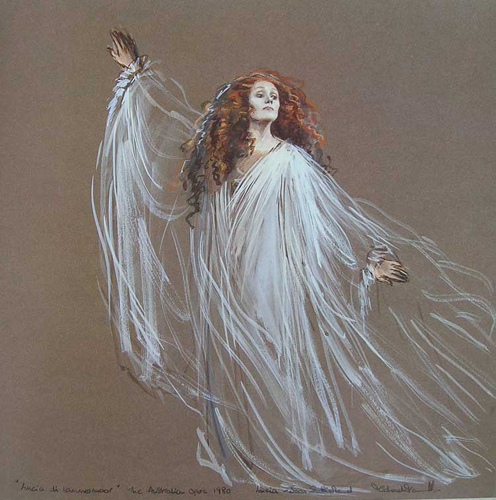
A painting inspired by Joan Sutherland's mad scene from Lucia di Lammermoor

Oh, how wonderful it would have been to be in the audience that night! Reports of Joan’s red locks flaming down her shoulders, Lucia’s white dress drenched in the blood of her unfortunate husband, dashing across the stage like a bewildered panther, all the while singing the most difficult music written in the 17th century. Callas was in the audience that night, and she was by all accounts enchanted by her former Clotilde’s massive success in one of the most important make-or-break roles of Italian repertoire.
Since that Lucia another success came in the form of what has been time and again called the most important classical vocal album of the 20th century: The Art of the Prima Donna. Made as a tribute to past pre-recording era divas such as Malibran, Patti and Pasta, the album was a massive hit, making Joan the Lady GaGa of her times. Here was a coloratura soprano, with a voice as massive as the continent from which she hailed, tackling music that had not been sung for one hundred years because of their difficulty, and running away with bloody murder. Even more surprising was Joan’s rendition of the fabled Willow Song from Verdi’s take of Otello: a silvery thread caressing the musical line, echoing the sad call of the mournful wind – Joan became Desdemona.
Early on the voice was silvery: a shimmering timbre full of opulent notes, capable of earth-shattering acuti and impressive locomotion. The speed of her rendition of famous cabalettas was legendary, as if defying laws of physics. And when she lets loose with her famous high Ds and E flats, it was like a meteor flashing across the heavens. Even more important than the fact that she conquered all the important stages five years after The Lucia, she began to unearth lost works like Beatrice di Tenda, Les Huguenots and Emilia di Liverpool, while touring the civilized world with bel canto bread-and-butter works like La sonnambula, I puritani, Semiramide and the queen of them all, Norma. She became La Stupenda, the stupendous one, to the hard-to-please loggione of La Fenice Opera in Venice. Then Massenet’s Esclarmonde happened.

Joan Sutherland as Esclarmonde (Met 1976)

Hearing Esclarmonde, a love story between a Byzantine witch-empress and a Crusader knight, for the first time, I can honestly tell you I did not sleep the night afterwards. How can one sleep when one keeps hearing Esclarmonde summoning her minions, demons of air and of water and of fire with staccati top Bs? How can one sleep when one keeps hearing Esclarmonde and Roland’s extremely erotic love duet, just musical phrases licking off each other, with sexual tension the likes which had never been heard since L’Incoronazione di Poppea? How can one sleep when one keeps hearing Esclarmonde’s desperate rage at Roland when he pulls off her veil, the mark of her powers, in front of a legion of overzealous priests?  How can one sleep when one keeps on picturing the confrontation scene between Esclarmonde and the priests who tried to bumrush her, when she overwhelms an entire ensemble of men with a massive D in alt? Not even the artless cover (depending on which version you get, it’s either Joan in full costume as Esclarmonde or just a picture of three gems) could deny that Joan’s Esclarmonde album should receive UNESCO Heritage status. Bellatrix Lestrange who? This Esclarmonde is one far more dangerous witch to cross.
With that Esclarmonde allegations that Sutherland cannot act was laid to rest. Nobody needs to act when one can draw vivid Kubrick-esque images in the audience’ mind just by singing the notes. But La Sutherland was not one to rest on her laurels. “Oh no she didn’t!” screamed the critics when she announced she was donning the iron claws of Turandot.
Now let’s put this into perspective: Turandot, the final work of Puccini (poor thing never did complete it, succumbing to carcinoma larynx) had a reputation of being a voice wrecker. Much like its bel canto sisters, Norma or the three Donizetti Queens; or its Wagnerian cousin, Brünnhilde; or its modern music grand-daughter Marie (in Wozzeck), Turandot could make a soprano famous or shatter her voice beyond all recognition (case in point: Guleghina’s 2009 Metropolitan Opera outing as the Pekingese princess). The issue of diction also came forward: Puccini was all about text, so how can a soprano whose greatest weakness is her consonants, or her lack thereof, could communicate the awesome libretto?

The recording session of Zubin Mehta's Turandot, 1972

When the result came out, it was like the nerdy guy who wears glasses who one day puts them away and reveals Wang Lee Hom’s eyes. Supported by the two greatest lyric voices of the day, namely Luciano Pavarotti (gasp!) and Montserrat Caballé (even more gasp!), Joan Sutherland took flight and became the greatest Turandot on record. Here was a Turandot who was capable of fulfilling all the demands of the score, but still managed to sound womanly. Her In questa reggia was monumental: I literally saw flashes of white light when Sutherland’s and Pavarotti’s top C’s rang out together. Her riddle scene was full of contempt and sneer, and complete with a chest voice so poisonous I wondered how Pavarotti could have sung his reply. And all the consonants amazingly survived! They floated on the Sutherland cruise and arrived on the port safely! The glorious ending scene was what it truly was: glorious, and the sceptical critics begrudgingly called her interpretation “possibly the best”.
And then the mistakes came. Joan Sutherland, like many other great divas before her and like many other great divas after her, clung on too long. Her Adriana Lecouvreur was the sort of recording people put on at parties just for laughs. She took on Lucrezia Borgia too late, when her voice has turned crone-like as opposed to maternal. Her Anna Bolena was saved only by her extreme commitment to acting, but it was painful to watch. As her fire burned dimmer and dimmer, Joan finally left the stage where she started, on hallowed Covent Garden, on New Year’s Eve of 1990.

Joan Sutherland at the Kennedy Center Honors 2004

During her retirement years, Joan became a sort of patron saint of vocal exercises. She became chief jury of the globally famous Cardiff Singer of The World competition, where she lamented on younger singers’ lack of technique. She made great stuff of one story of a young soprano who did not know how to breathe between phrases – this, in front of the soprano who brought her lungs all over the stratosphere. She courted controversy when one former secretary spilled the dirt on her, calling her out on racist name-calling against African-American soprano Kathleen ‘The Battle-Axe’ Battle, calling Pavarotti ‘a lazy farm boy’ and the charming American mezzo-soprano Frederica von Stade’s attempt at her signature role Amina ‘good-for-nothing’. The fire may be dim, people, but the embers are still glowing!
Then came the accident: Joan fell down in her Swiss home, breaking both legs. Her condition improved, but another ailment came: heart problems. Finally on 11th October 2010 the news came out and shocked the musical world: The Sutherland had sailed away for the last time.
It was hard. She was the Aunt figure, the one you’d expect to be always there. When she passed away I cried and put on The Art of the Prima Donna, the live recording of her debut Lucia, her Esclarmonde and Turandot, the video of her Canadian Opera Company Anna Bolena, charming clips of interviews of her with her husband, and Recording 1957-1962, a record of the young Joan singing random repertoire. It was bittersweet. There were many lonely nights in Manipal when my only company was Joan’s sweet voice, trilling away in Son vergin vezzosa, vanquishing away spineless himbos in Regarde-les ces yeux, contemplating an affair with a war veteran in Bel raggio lusinghier. I’ve heard her giggle in joy, I’ve heard her cry in desperate anguish, I’ve heard her lament her lost love, heartbroken at the altar. I’ve heard her waste away to death so many times, perhaps even more times than her ending happily with the tenor. In a way, Joan was a very close friend: this amazing, amazing voice that has transcended physical limitation to become, simply, music.
Farewell, Stupenda. Maybe I’ll hear your song again, in a better world.

Tuesday, December 28, 2010

#24 lied aus lotössblatter no. 2 breit über mein haupt (STRAUSS)

Breit' über mein Haupt dein schwarzes Haar,
neig' zu mir dein Angesicht,
da strömt in die Seele so hell und klar
mir deiner Augen Licht.

Ich will nicht droben der Sonne Pracht,
noch der Sterne leuchtenden Kranz,
ich will nur deiner Locken Nacht
und deiner Blicke Glanz.
Spread over my head thy raven locks
And turn thy head to me
so that thy gaze, so bright and clear,
will pierce my soul's eye.

I yearn neither for the Mighty Sun,
nor the crown of glittering Stars;
I only long for the night of your locks,
amidst thy radiant gaze.

(text: Adolf Friedrich, from Lotössblatter; translation: me)

***

The tempo marking is Andante maestoso. Despite this, a lot of singers seem to sing the lied faster, more towards Moderato. I am of the opinion that you cannot rush a plea to your lover lest she pick up her trestles and scurry away (though in retrospective, I am talking from a male perspective).

The piano marking is telling: molto legato. The line must be creamy, sweet and flawless: hence the breathing is to be controlled at all times. For example, it is always easier to let the line just fall down in the words schwarzes Haar, like a violin, and not let the chest come too much on Haar and make it sound like you're landing on muck.
 
Temptation is strong to accentuate strömt, but it is better to let the line just flow. Take a breath after so hell before flying into so klar. I like to add a crescendo-decrescendo (with lots of vibrato - wring it, baby!) at the syllable au of Augen Licht. And despite the arching phrase (typical of Strauss), it was actually quite easy on the lungs, PROVIDED you:
  1. take a breath after so hell before crescendoing into und klar
  2. don't spend too much time on klar, because the important part is deiner Augen Licht.
In fact I sometimes crescendo only on und; the klar I float: it gives an impression of light falling (the crescendo) and then shimmering (the float) on a glass of water (IMHO...).

Ich will nicht must sound a bit whiny. Make it sound that you already have a big toy to play with; why should you be given a new one? Usually I accent the syllable son- of Sonne (because it is a BIG thing, you know, the Sun) and the decrescendo on Pracht (with a little stress on PR-acht, because the word means strong). The next phrase should be delicate; you're talking about shimmering crown of stars, not the Halley comet. Although the crescendo is marked to start here, I usually shifted it into the next phrase: ich will nur deiner... because it makes more sense.

Ich will nur deiner Locken Nacht is the entire point of this lied. This is the Master Phrase, and it demands every single thing one can possibly have, and just a little bit more. Use the comma sign and take a HUGE GULP of BREATH before starting this phrase. Keep everything on the breath, and remember the line SHOULD FLOW. I think that the ff sign here is more of a demand of maximum colour as opposed to maximum volume i.e. it should be BIG AND BROAD, but IT SHOULDN'T BE TRUMPETED: think Leontyne Price as opposed to Birgit Nilsson. The descent from Lo- to Nacht in Locken Nacht should be delicate. I recommend holding Nacht on a beat (or at most for a dotted crotchet) and starting the portamento up to und on the next beat itself as opposed to waiting for a whole minim.

und deiner blicke Glanz is a bit like a mini Master Phrase. I don't agree with the accent markings on und deiner; it sounds weird and it tends to distort the phrase. I recommend a breath before BLICK- (Ideally, though, the entire phrase SHOULD BE IN ONE BREATH). Play with blicke any way you want it: the way that phrase was written it is OBVIOUS that it was meant to be caressed like so much vermillion silk. Glanz should sound something like a harp arpeggio: GL-a-ANZ.